Resident Astronomer David Vincent looks again at Celestial Bodies
How did we measure time before mechanical devices?
The day and night cycle is obvious, and fine for “let’s have a run the day after tomorrow”, but what about longer stretches of time?
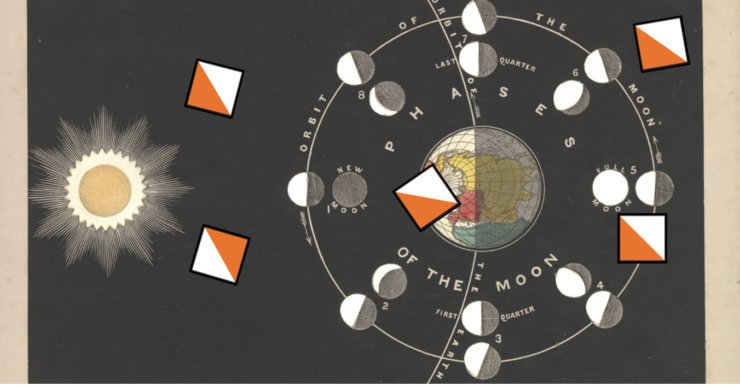
Our Moon is the next most obvious marker of time. Stone Age orienteering clubs might have debated:
“so, shall we settle for a Mammoth Fell event the day after the next full Moon?”, or:
“right then – we’ll have the next night event on the evening of the first quarter Moon of the next Moonth. We’ll be needing marshals with torches because of the sabre-tooths in that area”.
Of course, the Moon is such an obvious marker of the passage of time that it was used by all early civilisations, and many cultures still cling to it.
But how annoying of the Moon to not make a whole number of orbits of the Earth in the time it takes the Earth and Moon to orbit the Sun! The Earth round the Sun orbit takes 365.25 days, while the Moon round the Earth orbit takes about 29 days (see below on that about*). Well, dividing 365.25 by 29 gives a really inconvenient 12.6. This means that, if you want to measure longer spans of time, and you also care about the seasons – eg. when to plant your crops – you have a problem. Imagine – you plant your seeds one spring at the time of a waxing crescent Moon, and start counting the moonths … Whether you count to 12 or to 13, you are going to be at roughly the same time of the year, but crucially, not exactly the same time. Over a few years, your planting time is going to drift away from the optimum.
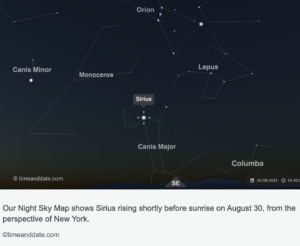
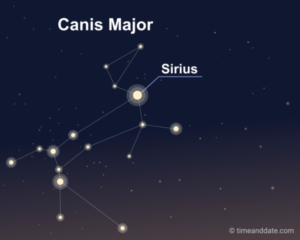 The Egyptians of around 3000 BC had this problem. They relied upon the annual flooding of the Nile to make their arable land fertile enough for their seeds. If they got it wrong, there could be a famine and hundreds would die. They needed a better way of measuring time – one that ignored the Moon. Measuring the height of the Sun at midday would work fine, but is technically difficult to do with sufficient accuracy. The Egyptians chose the rising of the Dog Star, Sirius (the brightest star visible from northern latitudes like ours). This star-based (essentially Sun-based) calendar worked much better. 3000 years later, Julius Caesar would learn this idea from Cleopatra and bring it to the Roman Empire. Caesar immediately saw how the Empire’s orienteering events calendar would benefit from such a system!
 But those moonths – it’s so useful to talk about these as chunks of time! So they persisted, but were modified by stuffing days in to all of them (except February, of course), so that we could have exactly 12 in a year.
By definition, a month would have exactly one first quarter, one full Moon, etc. But with the stuffing of the months with extra days, there is now the possibility, if the full Moon happens very early in the month – eg. on the 1st – that there could be a second full Moon in that same month. This second full Moon in a month is one of the definitions of a Blue Moon.
This May, we will have a Blue Moon, on May 31st. Enjoy it, and since it’s a Sunday, celebrate by going orienteering. [Apparently they only appear every 2–3 years, and aren’t actually blue. – Ed.]
Interestingly, pre-agricultural hunter-gatherers would have had no problems using the Moon: “Shall we have a party at the Big Stone Ring the moonth after next? Sprint event in the morning?”
* The Moon takes 27.3 days to orbit the Earth. However, the phase of the Moon depends on the Sun-Earth-Moon angle. During the moonth, the Earth and Moon move about a twelfth of their way around the Sun, so the Moon needs to do a little more than one complete orbit of Earth to make the angle the same again. So the time between successive full Moons is about 29.5 days (though it depends on how fast the Earth is moving in its orbit – a little slower in summer, a little quicker in winter – see my notes in an earlier edition)!