This history by Mike Gardner first appeared in EMEWS 301, leading up to our next East Midlands League event
DVO’s next regional event will take place at Allestree Park on 21 June (entries open on The Start Kite), so a brief history of the hall and park might be of interest.
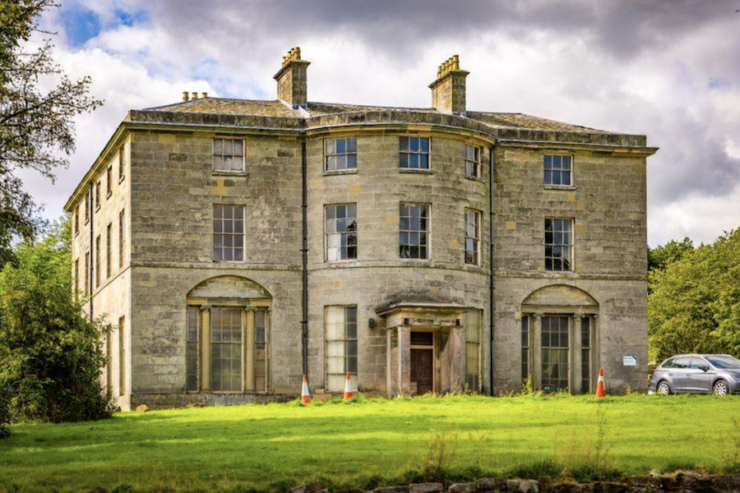
The Mundy family owned the Manor of Allestree from 1516 until Francis Noel Clarke Mundy sold it. Bache Thornhill bought the land in 1795 and demolished the house that stood there. He commissioned James Wyatt, the notable architect, to build the present Hall and the plans that were drawn up still exist. One stone in the building bears the date 1802 with the initials J.W. inscribed on it. The house begun by Bache Thornhill was completed by John Giradot (High Sheriff of Derbyshire) with three storeys and five bays, the central three bowed with an ionic columned porch. Around 1818, the surrounding parkland was enclosed.
John Charles Girardot was born in 1771 into a French Huguenot family. His father was Andrew Girardot and his grandfather was Paul Girardot de Charcourt. He became his grandmother’s heir in 1784 and was also an heir of his uncle. He lived at Allestree Hall for about 20 years and sold it to William Evans in 1824.
William Evans was one of the longest residents of Allestree Hall. He lived there for about thirty years between 1824 until his death in 1856. He was born in 1788 in Derbyshire, and was a grandson of Jedediah Strutt via his daughter Elizabeth.
His father, also called William Evans, was a very wealthy man. When he died William inherited a share in the Derby Bank, Darley cotton and paper mills, Derby waterworks and Bonsall lead smelting business. He was also lord of the manors of Brailsford, Alkmonton, Parwich and Newton Grange. In 1820 he married Mary Gisborne who was the daughter of the notable clergyman Rev. Thomas Gisborne. The couple had only one child, William.
William became a politician and was a known associate of William Wilberforce. He joined him in his fight against slavery. He and Wilberforce were both prominent members of the Anti-Slavery Society (1823–1838). A letter exists from William Evans to his sister which mentions that he has recently received correspondence from Wilberforce. William died at Allestree Hall in 1856 at the age of 68 and his only child Thomas William Evans inherited the property.
Thomas William Evans was born in 1821 at Allestree Hall. He was educated at Trinity College, Cambridge. After he graduated with a Master of Arts in 1846 he married his first cousin Mary Gisborne, the daughter of Thomas John Gisborne of Holme Hall near Bakewell. The couple had no children. He inherited his father’s fortune in 1856. He became a parliamentarian in 1857 and held this position for many years. He was also very prominent in local politics being the first Chairman of the Derbyshire County Council which was a position he held until his death. He was the Mayor of Derby in 1869 and was made a baronet in 1887. He died at Allestree Hall in 1892 and, as he had no children, he left the Hall to his brother-in-law William Gisborne.
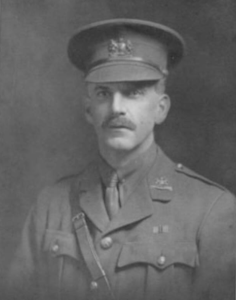
The house was passed through the Gisborne family, though sometimes they rented it out to others, then in 1913 Lionel Gisborne sold the property to Colonel Herbert Johnson. He became owner of a major wire company on the death of his father, and consequently very wealthy, marrying in New York City, a wealthy American lady Ethyl Barnard.
Herbert fought in World War I, was wounded in the Battle of the Somme, and eventually returned to Allestree to recover. However, on the evening of Saturday 7 July 1923 when he was out in Allestree Park he was struck by lightning during a severe thunderstorm and died. His wife Ethyl continued to live at the Hall until her death in 1928. [A unicyclist added that Ethyl had to claim that Herbert died from a heart attack, as a lightning strike was considered an ‘act of God’, which would have negated the claim. The horse, Septimus, is buried in the pet cemetery, shown by the pink arrow.]
The Hall was sold to Commercial Constructions Ltd around 1928. They 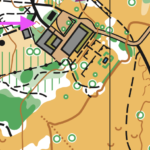 subdivided part of the land and released it in 1936. During the war the Hall was used by the National Fire Service as the County Headquarters. Derby Council purchased Allestree Hall in about 1946 and two years later constructed the golf course which surrounded the Hall until the early 2020s.
In the 1970s it was proposed that the Hall be demolished, but in the mid-1980s an outline scheme by the city’s museums service to turn the building into a natural history museum was put forward. However, by 1988 the scheme to create a ‘Derby Nature Museum’ had been abandoned, and no further use was found for the building, which continued to deteriorate.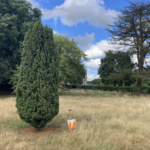
The park has currently been “rewilded” after closure of the golf course in 2020, and the current plan is to sell the Hall to a wedding venue operator. [Sal adds: The rewilding has meant that progress can be a little slower through the long grass, but it’s great to see so many insects and wild flowers!
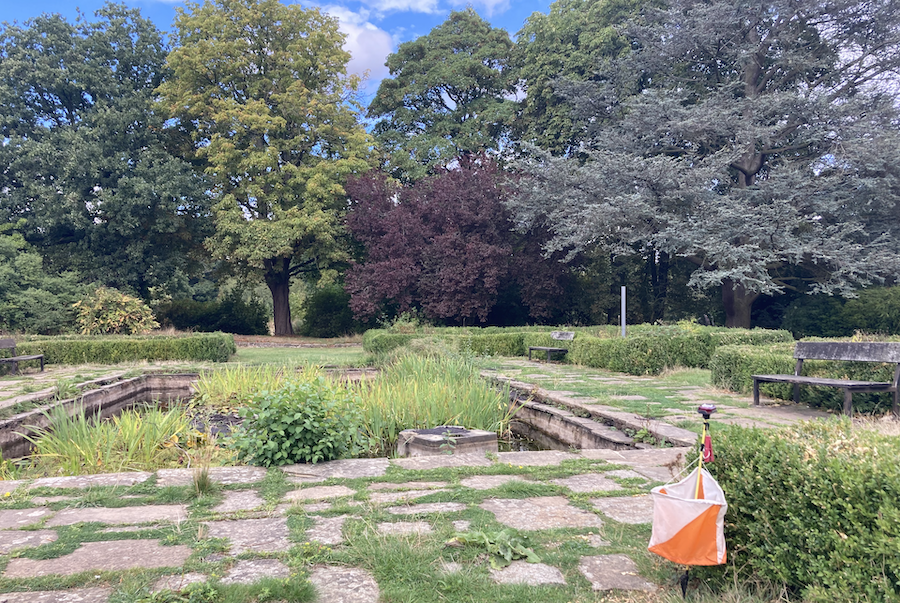
In the 1970s, the two bronze turtles from Derby River Gardens came to Allestree Park, where they spent four decades adorning the pond in the Hall’s formal garden. Nostalgic Allestree locals bemoaned their loss, but wished them well in their return to the city!]
We hope to see you on June 21st, details here. There will be the usual nine colour-coded courses, from White right up to Brown. The event is part of the East Midlands League, so many will enter their usual League course. Beginners however may enter any course they choose, but please come early if that choice is Brown!