The first in a series of safety tips by Jane Kayley-Burgess
Following the tragic death at Longshaw, a handful of DVO members met to discuss learning points. One thing was clear; orienteers can make a number of small changes which could make the difference between a safe outcome and a bad outcome, not just for the injured party, but for others who might become involved in the incident.
I have become somewhat sensitized by Longshaw and see something safety-related at a lot of the events I attend. I have sadly heard of fell runners who will not orienteer because orienteering doesn’t take safety seriously enough. I have witnessed young children in O tops, shivering in the snow waiting for their start times, heard a tale of a teenager on moorland in a hailstorm sobbing because she was so cold. I’ve seen an official at a Major event who wouldn’t send a competitor back for a forgotten whistle, just saying ‘It’s at your own risk’ and letting them go. Just recently I overheard someone say ‘They’ve asked us to carry phones. Why would they do that?’.
And there’s the rub; organisers tell/ask us to carry or wear certain items and we aren’t always sure why. Orienteers are a hardy bunch. We don’t like to run with ‘clutter’ because those extra 200g might just slow us down. And we don’t like being told what to do, even when it is for our own good. This is the first of a series of articles on the simple things that can make the difference between a good and a bad ending, and help to explain why overworked organisers ask you to be prepared.
Carry a whistle
Let’s start with something easy and seemingly obvious, so obvious you might not even bother to read this. But do; you might learn something. Most forest and moorland and some urban events mandate whistles, and nearly everyone carries one. Whistles can be used to attract people if we are injured, or if we find an injured competitor. A whistle is almost twice as loud as a loud shout, doesn’t go hoarse, uses less breath than a shout and makes a very distinctive sound.
Four things are important to know:
- when to carry it
- when and where to use it
- how to use it
- where to keep it.
When to carry it: Always, always carry a whistle if it is mandated. The rest is up to you but for me, the simple answer is always. Forest and moorland events are more obvious because you might be following a route choice which, for reasons including climb, ground and vegetation conditions, you’ve made a navigation error or you are one of the last out, few other competitors will take. Consider also carrying a whistle on urban, sprint and park events. You could trip and fall in a blind alleyway (possibly the wrong alleyway so it’s unlikely others will see you). You may be attacked (unlikely but not impossible) by a person or a dog.
When and where to use it: you trip and twist your ankle badly. It might be broken. Can you get back to Download? That’s the best option because there are most likely to be people and first aid equipment there. If not, can you get to the Finish? Still too painful? Can you drag yourself to the nearest control where there is a better chance of someone finding you if you blow your whistle and, importantly, of them being able to describe your position? Worst case, the control collectors will find you. If not, use your whistle now. All the above applies if you find an injured competitor.
How: Six strong short blasts, a minute break, then six more blasts. There’s no point in blowing once and hoping someone has heard, known it’s a whistle and not a buzzard, taken a bearing and come straight to you. If you hear a distress call, respond with three short blasts and continue to communicate in this way until you find each other. Likewise, if you find an injured competitor who hasn’t got or can’t use a whistle, use six blasts to attract more help.
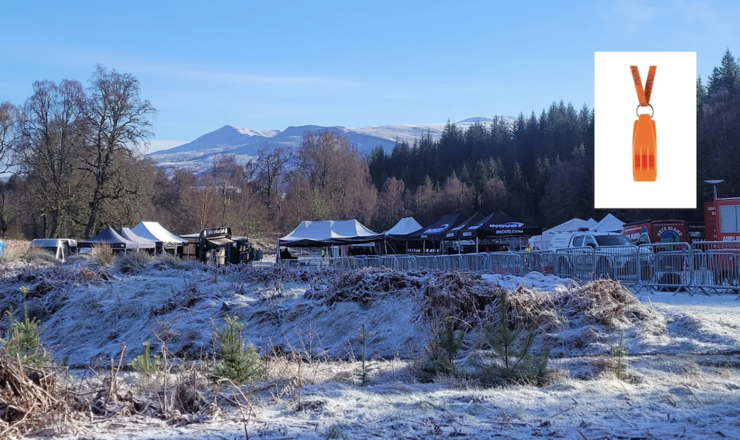
Where to keep your whistle: small flat whistles sit nicely in the back pocket of your most used O top or running pants. Many, many whistles are kept here. Many are tucked into bramble bashers or socks, some into shoes. But what if you have fallen on your back or are stuck waist deep in a bog and can’t reach your whistle? Consider pinning it to your top or wrist band or have it round your neck on a string that will snap before it strangles you should it get caught on a branch. Many sports vests have built in whistles, but if you’re relying on those, ensure they are designed so that you can sustain a good blast.
And finally
Wherever you decide to keep your whistle, consider taking it out with you whether you’re orienteering, out for a training run on your own, especially in the dark or even dog walking alone. It’s a very simple habit that could make a difference. Importantly, if you don’t want to carry a whistle at every event, check the final details and see if they are mandated and please do not give the officials grief if their job is to check you have one.
Next time: Medical forms and bracelets