Ex-member Dave Nevell elaborates on John Hawkins’s thoughts on when to cut corners
In the days before 2023 when Newstrack was still produced for print, we had a lot of these discussions, so it’s nice to get some dialogue back! Here, we prove that great minds really do think alike, as John’s article appeared in September.
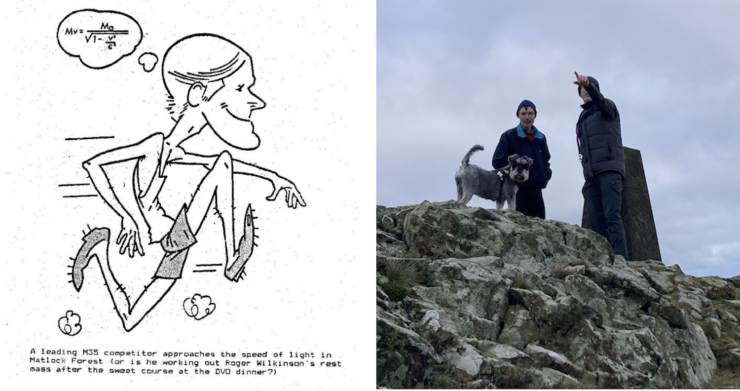
For newer members, Dave and his terrier Twiggy moved to ERYRI (not EVRi; please keep up at the back) a few years ago but Dave still holds the post of “resident statistician” for DVO, and published a fanzine that ran for about 10 years in Newstrack, collected here When Sunday Comes. He also writes regularly for the national orienteering magazine, CompassSport.
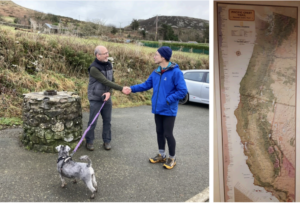
Before we dive into analysis, some Club members will be interested to hear that Dave and Twiggy have this year walked the equivalent of 1400 miles of the 3000-mile-long Continental Divide Trail. Twiggy didn’t enjoy walking in the summer heat, but they are making up for that now.
In 2024 Dave and Twiggy compleated the equivalent distance of the Appalachian Way, and 2025 saw them ‘compleat’ (Izaak Walton spelling) the Pacific Crest Trail.
Without further ado, here is Dave’s treatment of John’s dilemma …
Technical note – Snell’s Law
[appeared in the ERYRI newsletter in July 2026]
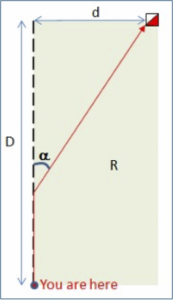 Here’s the deal. You are running due north along a long straight track at a constant speed. To your right the terrain is uniformly runnable, but slower than the track by a factor R (0<R<1). So for example, if R was 0.8, the terrain would be 80% runnable, probably what we might call “slow run”. To be frank, it’s all a bit dull and you continue to plod along, wondering what to have for tea, when you are suddenly jolted out of your reverie by the realisation that you are finally approaching the next control. The planner has been kind; visibility is good and you can see the feature that you are aiming for from a long way off. It’s decision time. At what point do you leave the track and head off cross-country towards the control, situated distance d from the track? Put another way, what should angle α be in order to minimise the time it takes to get to the control.
If maths isn’t your thing, then feel free to jump the next bit and rejoin us at [SLOTH ICON]
You quickly note that if you choose to leave the path on an angle α the time it will take you to reach the control is proportional to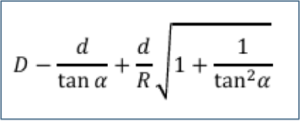
To minimise this time you deduce that this involves choosing α in order to minimise the expression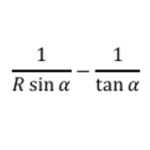
[SLOTH ICON] Hello, it’s safe(ish) to come out now. To minimise the time to reach the control we need to leave the path when the angle to the control is equal to arcos(R), which means “the angle whose cosine is R”. You figure that the terrain is indeed slow run (R=0.80) but your calculations fall at the last hurdle as you seem to have left your trigonometric tables at home on the kitchen table. Close but no cigar!
The really interesting thing that strikes you about this (trust me) is that the derived expression does not include either D, the distance along the main path to get level with the control, or d, the shortest distance from the path to the control. It doesn’t involve the speed of the runner either. This means that it has universal applicability for any track, any control off the track, and any orienteer. This feels like it might be profound but you have no time to ponder profundity as angle α is ever increasing as you continue running along the path and you don’t want to miss your optimal launch into the terrain.
What does it all mean in practice? Let’s assume R takes one of the following four values:
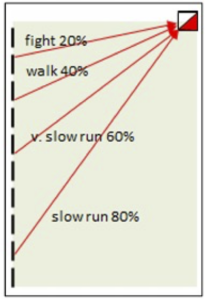 0.8 (slow run)
0.6 (very slow run)
0.4 (walk)
0.2 (fight).
What does that make α? The respective answers are:
36.9 degrees
53.1 degrees
66.4 degrees
78.5 degrees. These are shown on the diagram.
The argument can be reversed; the same routes would apply when leaving the control and joining the track. In fact, since the start of a leg involves a lot less navigational effort than the end of a leg, this advice may be better used in the former context. Navigating into a feature needs to take into account a lot more than just the runnability of the terrain.
What’s all this got to do with Snell? Is this a trick that only Mike uses? Maybe he does but the key thing to note is that the route that an orienteer should take is the same as light would. Snell’s Law describes how light bends when crossing the boundary between two media with different refractive indices. In fact, the Law can be extended to apply to more than one boundary which means it will guide you on how to run across several bands of terrain that have variable runnability. So to summarise, when you run it’s best to behave like light would, both in direction and, as far as you can manage it, in speed too.
For the really keen, Snell’s law is expressed mathematically as:
n₁ sin θ₁ = n₂ sin θ₂ where:
n₁ and n₂ are the refractive indices of the first and second media, respectively
θ₁ is the angle of incidence (between the incident ray and the normal)
θ₂ is the angle of refraction (between the refracted ray and the normal)