
The third in a series of safety tips by Jane Kayley-Burgess
So now we are running with a whistle (always) and, if we have a medical condition, ensuring we have something about our person or at Download, that tells people the condition we have, what we take for it and whether we carry the medication. Next we will look at leg cover.
Wearing full leg cover (and occasionally full body cover)
Most events, other than those where we run around towns and cities, suggest full leg cover. Some mandate it because those people know just how bad it can be out there. DVO members are very compliant, probably because they have spent a lot of time in bramble-infested woodland and know that shorts just don’t cut it.
It’s different for first timers or people who aren’t used to long stripey socks or padded gaiters. And it’s hard for officials to send people away when they turn up in shorts on a hot day.
Correct leg cover, that does the job it’s designed for, is so important. It doesn’t just protect us from the weather (sun, as well as rain and snow), it can protect us from whatever we are running through. This can be nettles, brambles or bracken which has dried hard and spikey, and which might result in a bit of a sting or a scratch. Blood is a bit of a badge of honour in our sport and no one minds a trickle. If you’re on blood thinners, the trickle might be more persistent and result in severe bruising, an infection and even cellulitis so it is very wise to avoid even a scratch. But it’s important to consider that there may be something more serious in the woods and across moorland, like ticks, gorse or sharp, snapped off pine branches, rose thorns or barbed wire.
Ticks in the UK pose a growing threat to public health. Climate change is a major driver; warmer, wetter winters have led to reports of tick activity even in winter months. Ticks are no longer confined to the Lakes and parts of Scotland. I have found them after walking in woodland in Derbyshire, some so small they were barely visible.
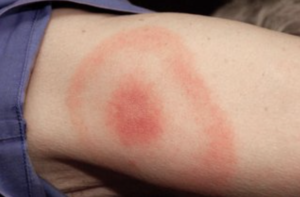
Lyme disease remains the primary concern, with over 1,500 laboratory-confirmed cases in 2024, though actual clinical cases may reach 4,000 annually. Roughly 4–6% of ticks carry the bacteria. Most of us probably know someone who has had Lyme disease. It can take years to recover, often leaving long-term effects such as exhaustion, muscle or joint pain and brain fog.
Tick-borne Encephalitis Virus (TBEV) has recently emerged as a rare but serious threat in areas like North Yorkshire and Thetford Forest. Both diseases can be debilitating.
Prevention is key so take any advice from an organiser seriously: wear long sleeves and complete leg cover, use repellents like DEET and perform thorough “tick checks” after outdoor activities.
For more information, use these links and if you suspect you have been infected, seek professional medical advice at once.
https://www.nhs.uk/conditions/lyme-disease/
https://www.nhs.uk/conditions/tick-borne-encephalitis/
Penetration wounds caused by thorns can introduce fungi, straphylococcus or tetanus. A long-sleeved O top might not be fully effective against a wild rose (so prevalent in relatively new plantations) or gorse, sea buckthorn or hawthorn, but they will give some protection. If you suspect a wound has become infected, seek medical advice and check your tetanus immunisation is up to date.
POST-SCRIPT
Three club members report having Lyme disease in the last few years. One, who was a spectating her partner, picked it up from a park in Scarborough. She didn’t have the usual bullseye rash, but asked her GP for a test anyway, because she’d felt an insect bite and knew about the risk to orienteers. A 3-week course of antibiotics was prescribed, and we’re glad that early detection helped!
POST POST-SCRIPT
Vaccination for Lyme disease is available – it’s a course of 3 – at Superdrug Health Clinics: